Last years
Last years
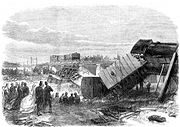
Crash scene after the Staplehurst rail crash
On 9 June 1865,while returning from Paris with Ternan, Dickens was involved in the Staplehurst rail crash in which the first seven carriages of the train plunged off a cast iron bridge that was being repaired. The only first-class carriage to remain on the track was the one in which Dickens was travelling. Dickens spent some time trying to help the wounded and the dying before rescuers arrived. Before leaving, he remembered the unfinished manuscript for Our Mutual Friend, and he returned to his carriage to retrieve it. Typically, Dickens later used this experience as material for his short ghost story The Signal-Man in which the central character has a premonition of his own death in a rail crash. He based the story around several previous rail accidents, such as the Clayton Tunnel rail crash of 1861.
Dickens managed to avoid an appearance at the inquest into the crash, as it would have become known that he was travelling that day with Ternan and her mother, which could have caused a scandal. Although unharmed, Dickens never really recovered from the Staplehurst crash, and his normally prolific writing shrank to completing Our Mutual Friend and starting the unfinished The Mystery of Edwin Drood after a long interval. Much of his time was taken up with public readings from his best-loved novels. Dickens was fascinated by the theatre as an escape from the world, and theatres and theatrical people appear in Nicholas Nickleby. The travelling shows were extremely popular. In 1866, a series of public readings were undertaken in England and Scotland. The following year saw more readings in England and Ireland.

Photograph of Dickens taken by Jeremiah Gurney & Son, New York, 1867.
“Charles Dickens”.Wikipedia, The Free Encyclopedia. 23 octubre 2009