Middle years
Middle years
In 1856, his popularity had allowed him to buy Gad’s Hill Place. This large house in Higham, Kent, had a particular meaning to Dickens as he had walked past it as a child and had dreamed of living in it. The area was also the scene of some of the events of Shakespeare’s Henry IV, part 1 and this literary connection pleased him.
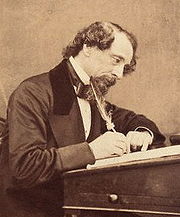
At his desk in 1858
In 1857, in preparation for public performances of The Frozen Deep, a play on which he and his protégé Wilkie Collins had collaborated, Dickens hired professional actresses to play the female parts. With one of these, Ellen Ternan, Dickens formed a bond which was to last the rest of his life. When he separated from his wife, Catherine, in 1858, divorce was almost unthinkable, particularly for someone as famous as he was, and he financially supported her long afterwards. Although they appeared to be initially happy together, Catherine did not seem to share quite the same boundless energy for life which Dickens had. Nevertheless, her job of looking after their ten children, the pressure of living with a world-famous novelist, and keeping house for him, certainly did not help. An indication of his marital dissatisfaction may be seen when, in 1855, he went to meet his first love, Maria Beadnell. Maria was by this time married as well, but seemed to have fallen short of Dickens’s romantic memory of her.
During this period, whilst pondering about giving public readings for his own profit, Dickens was approached by Great Ormond Street Hospital to help it survive its first major financial crisis through a charitable appeal. Dickens, whose philanthropy was well-known, was asked to preside by the hospital’s founder Charles West, who happened to be a friend of the author’s. He threw himself into the task, heart and soul (a little known fact is that Dickens reported anonymously in the weekly The Examiner in 1849 to help mishandled children and wrote another article to help publicise the hospital’s opening in 1852). On 9 February 1858, Dickens spoke at the hospital’s first annual festival dinner at Freemasons’ Hall and later gave a public reading of A Christmas Carol at St. Martin-in-the-Fields church hall. The events raised enough money to enable the hospital to purchase the neighbouring house, No. 48 Great Ormond Street, increasing the bed capacity from 20 to 75.
That summer of 1858, after separating from his wife, Dickens would undertake his first series of public readings in London for pay which ended on 22 July. After a mere 10 days rest, however, he began a gruelling and ambitious tour, which would take him through the English provinces, Scotland and Ireland, beginning with a performance in Clifton on 2 August and closing in Brighton, more than three months later, on 13 November. Altogether he was scheduled to read eighty-seven times, on some days giving both a matinée and an evening performance.
Major works, A Tale of Two Cities (1859); and Great Expectations (1861) soon followed and would prove resounding successes with both his critics and his fans. During this time he was also the publisher and editor of, and a major contributor to, the journals Household Words (1850–1859) and All the Year Round (1858–1870). A recurring theme in Dickens’s writing, both as reportage for these publications and as an inspiration for his fiction, reflected the public’s interest in Arctic exploration: the heroic friendship between explorers John Franklin and John Richardson gave the idea for A Tale of Two Cities, The Wreck of the Golden Mary and the play The Frozen Deep. In early September 1860, in a field behind Gad’s Hill, Dickens made a great bonfire of nearly his entire correspondence. Only those letters on business matters were spared. Since Ellen Ternan burned all of his letters as well, the dimensions of the affair between the two were unknown until the publication of Dickens and Daughter, a book about Dickens’s relationship with his daughter Kate, in 1939. Kate Dickens worked with author Gladys Storey on the book prior to her death in 1929, and alleged that Dickens and Ternan had a son who died in infancy, though no contemporary evidence exists. On his death, Dickens settled an annuity on Ternan which made her a financially independent woman. Claire Tomalin’s book, The Invisible Woman, set out to prove that Ternan lived with Dickens secretly for the last 13 years of his life, and was subsequently turned into a play, Little Nell, by Simon Gray.
In the same period, Dickens furthered his interest in the paranormal, so much that he was one of the early members of The Ghost Club.
“Charles Dickens”.Wikipedia, The Free Encyclopedia. 23 octubre 2009