Farewell readings

Posted in Dickens-> Bio 10: Farewell readings on octubre 31st, 2009 by pasla

Farewell readings

Between 1868 and 1869, Dickens gave a series of «farewell readings» in England, Scotland, and Ireland, until he collapsed on 22 April 1869, at Preston in Lancashire showing symptoms of a mild stroke.After further provincial readings were cancelled, he began work on his final novel, The Mystery of Edwin Drood. In an opium den in Shadwell, he witnessed an elderly pusher known as «Opium Sal», who subsequently featured in his mystery novel.


Poster promoting a reading by Dickens in Nottingham dated Feb. 4, 1869; two months before he suffered a mild stroke

When he had regained sufficient strength, Dickens arranged, with medical approval, for a final series of readings at least partially to make up to his sponsors what they had lost due of his illness. There were to be twelve performances, running between 11 January and 15 March 1870, the last taking place at 8:00 pm at St. James’s Hall in London. Although in grave health by this time, he read A Christmas Carol and The Trial from Pickwick. On 2 May, he made his last public appearance at a Royal Academy Banquet in the presence of the Prince and Princess of Wales, paying a special tribute to the passing of his friend, illustrator Daniel Maclise.

“Charles Dickens”.Wikipedia, The Free Encyclopedia. 23 octubre 2009

 http://en.wikipedia.org/wiki/Charles_Dickens

Second visit to America

Posted in Dickens-> Bio 09: second visit to America on octubre 31st, 2009 by pasla

Second visit to America

On 9 November 1867, Dickens sailed from Liverpool embarking on his second American reading tour, which continued into 1868. Landing at Boston on 19 November, he devoted the rest of the month to a round of dinners there with such notables as Ralph Waldo Emerson, Henry Wadsworth Longfellow and his American publisher James Thomas Fields. In early December, the readings began and Dickens spent the month shuttling between Boston and New York. Although he had started to suffer from what he called the «true American catarrh», he kept to a schedule that would have challenged a much younger man, even managing to squeeze in some sleighing in Central Park. In New York, he gave 22 readings at Steinway Hall between 9 December 1867 and 18 April 1868, and four at Plymouth Church of the Pilgrims between 16 January and 21 January 1868. During his travels, he saw a significant change in the people and the circumstances of America. His final appearance was at a banquet the American Press held in his honour at Delmonico’s on 18 April, when he promised to never denounce America again. By the end of the tour, the author could hardly manage solid food, subsisting on champagne and eggs beaten in sherry. On 23 April, he boarded his ship to return to Britain, barely escaping a Federal Tax Lien against the proceeds of his lecture tour.

“Charles Dickens”.Wikipedia, The Free Encyclopedia. 23 octubre 2009

 http://en.wikipedia.org/wiki/Charles_Dickens
Last years

Posted in Dickens-> Bio 08: Last years on octubre 31st, 2009 by pasla

Last years


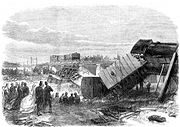
Crash scene after the Staplehurst rail crash

On 9 June 1865,while returning from Paris with Ternan, Dickens was involved in the Staplehurst rail crash in which the first seven carriages of the train plunged off a cast iron bridge that was being repaired. The only first-class carriage to remain on the track was the one in which Dickens was travelling. Dickens spent some time trying to help the wounded and the dying before rescuers arrived. Before leaving, he remembered the unfinished manuscript for Our Mutual Friend, and he returned to his carriage to retrieve it. Typically, Dickens later used this experience as material for his short ghost story The Signal-Man in which the central character has a premonition of his own death in a rail crash. He based the story around several previous rail accidents, such as the Clayton Tunnel rail crash of 1861.

Dickens managed to avoid an appearance at the inquest into the crash, as it would have become known that he was travelling that day with Ternan and her mother, which could have caused a scandal. Although unharmed, Dickens never really recovered from the Staplehurst crash, and his normally prolific writing shrank to completing Our Mutual Friend and starting the unfinished The Mystery of Edwin Drood after a long interval. Much of his time was taken up with public readings from his best-loved novels. Dickens was fascinated by the theatre as an escape from the world, and theatres and theatrical people appear in Nicholas Nickleby. The travelling shows were extremely popular. In 1866, a series of public readings were undertaken in England and Scotland. The following year saw more readings in England and Ireland.


Photograph of Dickens taken by Jeremiah Gurney & Son, New York, 1867.

“Charles Dickens”.Wikipedia, The Free Encyclopedia. 23 octubre 2009

 http://en.wikipedia.org/wiki/Charles_Dickens

The Franklin incident

Posted in Dickens-> Bio 07: The Franklin incident on octubre 31st, 2009 by pasla

The Franklin incident

After Franklin died in unexplained circumstances on an expedition to find the North West Passage it was natural for Dickens to write a piece in Household Words defending his hero against the discovery in 1854, some four years after the search began, of evidence that Franklin’s men had, in their desperation, resorted to cannibalism. Without adducing any supporting evidence he speculates that, far from resorting to cannibalism amongst themselves, the members of the expedition may have been «set upon and slain by the Esquimaux…We believe every savage to be in his heart covetous, treacherous, and cruel.» Although publishing in a subsequent issue of Household Words a defence of the Esquimaux, written by John Rae, one of Franklin’s rescue parties, who had actually visited the scene of the supposed cannibalism, Dickens refused to alter his view.

“Charles Dickens”.Wikipedia, The Free Encyclopedia. 23 octubre 2009

 http://en.wikipedia.org/wiki/Charles_Dickens
Middle years

Posted in Dickens-> Bio 06: Middle years, Dickens-> Biography on octubre 31st, 2009 by pasla

Middle years

In 1856, his popularity had allowed him to buy Gad’s Hill Place. This large house in Higham, Kent, had a particular meaning to Dickens as he had walked past it as a child and had dreamed of living in it. The area was also the scene of some of the events of Shakespeare’s Henry IV, part 1 and this literary connection pleased him.


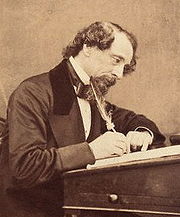
At his desk in 1858

In 1857, in preparation for public performances of The Frozen Deep, a play on which he and his protégé Wilkie Collins had collaborated, Dickens hired professional actresses to play the female parts. With one of these, Ellen Ternan, Dickens formed a bond which was to last the rest of his life. When he separated from his wife, Catherine, in 1858, divorce was almost unthinkable, particularly for someone as famous as he was, and he financially supported her long afterwards. Although they appeared to be initially happy together, Catherine did not seem to share quite the same boundless energy for life which Dickens had. Nevertheless, her job of looking after their ten children, the pressure of living with a world-famous novelist, and keeping house for him, certainly did not help. An indication of his marital dissatisfaction may be seen when, in 1855, he went to meet his first love, Maria Beadnell. Maria was by this time married as well, but seemed to have fallen short of Dickens’s romantic memory of her.

During this period, whilst pondering about giving public readings for his own profit, Dickens was approached by Great Ormond Street Hospital to help it survive its first major financial crisis through a charitable appeal. Dickens, whose philanthropy was well-known, was asked to preside by the hospital’s founder Charles West, who happened to be a friend of the author’s. He threw himself into the task, heart and soul (a little known fact is that Dickens reported anonymously in the weekly The Examiner in 1849 to help mishandled children and wrote another article to help publicise the hospital’s opening in 1852). On 9 February 1858, Dickens spoke at the hospital’s first annual festival dinner at Freemasons’ Hall and later gave a public reading of A Christmas Carol at St. Martin-in-the-Fields church hall. The events raised enough money to enable the hospital to purchase the neighbouring house, No. 48 Great Ormond Street, increasing the bed capacity from 20 to 75.

That summer of 1858, after separating from his wife, Dickens would undertake his first series of public readings in London for pay which ended on 22 July. After a mere 10 days rest, however, he began a gruelling and ambitious tour, which would take him through the English provinces, Scotland and Ireland, beginning with a performance in Clifton on 2 August and closing in Brighton, more than three months later, on 13 November. Altogether he was scheduled to read eighty-seven times, on some days giving both a matinée and an evening performance.

Major works, A Tale of Two Cities (1859); and Great Expectations (1861) soon followed and would prove resounding successes with both his critics and his fans. During this time he was also the publisher and editor of, and a major contributor to, the journals Household Words (1850–1859) and All the Year Round (1858–1870). A recurring theme in Dickens’s writing, both as reportage for these publications and as an inspiration for his fiction, reflected the public’s interest in Arctic exploration: the heroic friendship between explorers John Franklin and John Richardson gave the idea for A Tale of Two Cities, The Wreck of the Golden Mary and the play The Frozen Deep. In early September 1860, in a field behind Gad’s Hill, Dickens made a great bonfire of nearly his entire correspondence. Only those letters on business matters were spared. Since Ellen Ternan burned all of his letters as well, the dimensions of the affair between the two were unknown until the publication of Dickens and Daughter, a book about Dickens’s relationship with his daughter Kate, in 1939. Kate Dickens worked with author Gladys Storey on the book prior to her death in 1929, and alleged that Dickens and Ternan had a son who died in infancy, though no contemporary evidence exists. On his death, Dickens settled an annuity on Ternan which made her a financially independent woman. Claire Tomalin’s book, The Invisible Woman, set out to prove that Ternan lived with Dickens secretly for the last 13 years of his life, and was subsequently turned into a play, Little Nell, by Simon Gray.

In the same period, Dickens furthered his interest in the paranormal, so much that he was one of the early members of The Ghost Club.

“Charles Dickens”.Wikipedia, The Free Encyclopedia. 23 octubre 2009

 http://en.wikipedia.org/wiki/Charles_Dickens

Philanthropy

Posted in Dickens-> Bio 05: Philanthropy on octubre 31st, 2009 by pasla

Philanthropy

In May 1846, Angela Burdett Coutts, the wealthy heir to the Coutts banking fortune, approached Dickens about setting up a home for the redemption of «fallen» women. Coutts envisioned a home that would offer a different approach to other organizations that offered a harsh and punishing regimen for these women, and instead provide a disciplined but supportive environment where they could learn to read and write and become proficient in domestic household chores so as to re-integrate them into society gently. After initially resisting, Dickens eventually founded the home, named Urania Cottage, in the Lime Grove section of Shepherds Bush. He would end up becoming involved in many aspects of its day-to-day running, setting the house rules, reviewing the accounts and also interviewing prospective residents, some of whom became characters in his books. He would scour prisons and workhouses for potentially suitable candidates and relied on friends, such as the Magistrate John Hardwick to bring them to his attention. Once found, each potential candidate was given an anonymous printed invitation written by Dickens called ‘An Appeal to Fallen Women’, which he signed only as ‘Your friend’. If the woman accepted the invitation, Dickens would personally interview her and decide if she could be admitted to the home.In late November 1851, Dickens moved into Tavistock House where he would write Bleak House (1852–53), Hard Times (1854) and Little Dorrit (1857). It was here he got up the amateur theatricals which are described in Forster’s Life.

“Charles Dickens”.Wikipedia, The Free Encyclopedia. 23 octubre 2009

 http://en.wikipedia.org/wiki/Charles_Dickens

First visit to America

Posted in Dickens-> Bio 04: First visit to America on octubre 31st, 2009 by pasla

First visit to America

In 1842, Dickens made his first trip to America travelling with his wife to the United States and Canada, a journey which was successful in spite of his support for the abolition of slavery. The trip is described in the short travelogue American Notes for General Circulation and is also the basis of some of the episodes in Martin Chuzzlewit. Dickens includes in Notes a powerful condemnation of slavery,with «ample proof» of the «atrocities» he found. He called upon President John Tyler at the White House.


Photograph of the author, c. 1849

During this visit, Dickens spent time in New York City, where he gave lectures, raised support for copyright laws, and recorded many of his impressions of America. He toured the City for a month, and met such luminaries as Washington Irving and William Cullen Bryant. On 14 February 1842, a Boz Ball (named after his pseudonym) was held in his honour at the Park Theater, with 3,000 of New York’s elite present. Among the neighbourhoods he visited were Five Points, Wall Street, The Bowery, and the prison known as The Tombs.At this time Georgina Hogarth, another sister of Catherine, joined the Dickens household, now living at Devonshire Terrace, Marylebone, to care for the young family they had left behind.She remained with them as housekeeper, organiser, adviser and friend until her brother-in-law’s death in 1870.

Shortly thereafter, he began to show interest in Unitarian Christianity, although he remained an Anglican, at least nominally, for the rest of his life. Dickens’s work continued to be popular, especially A Christmas Carol written in 1843, the first of his Christmas books, which was reputedly a potboiler written in a matter of weeks to meet the expenses of his wife’s fifth pregnancy. After living briefly abroad in Italy (1844) and Switzerland (1846), Dickens continued his success with Dombey and Son (1848); David Copperfield (1849–50).

“Charles Dickens”.Wikipedia, The Free Encyclopedia. 23 octubre 2009

 http://en.wikipedia.org/wiki/Charles_Dickens

Journalism and early novels

Posted in Dickens-> Bio 03: Journalism and early novels on octubre 31st, 2009 by pasla

Journalism and early novels

In 1833, Dickens was able to get his very first story, A Dinner at Poplar Walk, published in the London periodical, Monthly Magazine. The following year he rented rooms at Furnival’s Inn becoming a political journalist, reporting on parliamentary debate and travelling across Britain by stagecoach to cover election campaigns for the Morning Chronicle. His journalism, in the form of sketches which appeared in periodicals, formed his first collection of pieces Sketches by Boz which was published in 1836 and led to the serialization of his first novel, The Pickwick Papers, in March 1836. He continued to contribute to and edit journals throughout much of his subsequent literary career. Dickens’s keen perceptiveness, intimate knowledge and understanding of the people, and tale-spinning genius were quickly to gain him world renown and wealth.


An 1839 portrait of a young Charles Dickens by Daniel Maclise

In 1836, Dickens accepted the job of editor of Bentley’s Miscellany, a position that he would hold for three years, when he fell out with the owner. At the same time, his success as a novelist continued, producing Oliver Twist (1837–39), Nicholas Nickleby (1838–39), The Old Curiosity Shop and, finally, Barnaby Rudge: A Tale of the Riots of ‘Eighty as part of the Master Humphrey’s Clock series (1840–41)—all published in monthly instalments before being made into books. Dickens had a pet raven named Grip which, when it died in 1841, Dickens had stuffed (it is now at the Free Library of Philadelphia).

On 2 April 1836, he married Catherine Thomson Hogarth (1816 – 1879), the daughter of George Hogarth, editor of the Evening Chronicle. After a brief honeymoon in Chalk, Kent, they set up home in Bloomsbury. They had ten children:

On 25 March 1837, Dickens moved with his family into 48 Doughty Street, London, (on which he had a three year lease at £80 a year) where he would remain until December 1839. A new addition to the household was Dickens’s younger brother Frederick. Also, Catherine’s 17 year old sister Mary moved with them from Furnival’s Inn to offer support to her newly married sister and brother-in-law. It was not unusual for a woman’s unwed sister to live with and help a newly married couple. Dickens became very attached to Mary, and she died in his arms after a brief illness in 1837. She became a character in many of his books, and her death is fictionalized as the death of Little Nell.

“Charles Dickens”.Wikipedia, The Free Encyclopedia. 23 octubre 2009

 http://en.wikipedia.org/wiki/Charles_Dickens

Early years

Posted in Dickens-> Bio 02: Early years on octubre 31st, 2009 by pasla

Early years

Dickens was born on 7 February 1812, in Landport, Portsmouth, in Hampshire, the second of eight children to John Dickens (1786–1851), a clerk in the Navy Pay Office at Portsmouth, and his wife, Elizabeth (née Barrow, 1789–1863). He was christened at St Mary’s Church in Portsea on 4 March 1812. When he was five, the family moved to Chatham, Kent. In 1822, when he was ten, the family relocated to 16 Bayham Street, Camden Town, in London.


Birthplace of Dickens: No. 1 Mile End Terrace, Landport (now 393 Commercial Road, Portsmouth)

His early years seem to have been an idyllic time, although he thought himself then a «very small and not-over-particularly-taken-care-of boy».He spent time outdoors, but also read voraciously, with a particular fondness for the picaresque novels of Tobias Smollett and Henry Fielding. He talked, later in life, of his extremely poignant memories of childhood, and of his continuing photographic memory of the people and events that helped to bring his fiction to life. His family’s early, moderate wealth provided the boy Dickens with some private education at William Giles’s School, in Chatham.This time of prosperity came to an abrupt end, however, when his father spent beyond his means in entertaining and in retaining his social position, and was finally imprisoned at Marshalsea debtor’s prison. Shortly afterwards, the rest of his family joined him in residence at Marshalsea, south of the Thames, (except for Charles, who boarded in Camden Town at the house of family friend Elizabeth Roylance). Sundays became a treat, when with his sister Fanny, allowed out from the Royal Academy of Music, he spent the day at the Marshalsea.The prison provided the setting of one of his works, Little Dorrit, and is where the title character’s father is imprisoned.

Just before his father’s arrest, 12-year-old Dickens had begun working ten-hour days at Warren’s Blacking Warehouse, on Hungerford Stairs, near the present Charing Cross railway station. He earned six shillings a week pasting labels on jars of thick shoe polish. This money paid for his lodgings with Mrs. Roylance and helped support his family. Mrs. Roylance, Dickens later wrote, was «a reduced old lady, long known to our family», and whom he eventually immortalized, «with a few alterations and embellishments», as «Mrs. Pipchin», in Dombey & Son. Later, lodgings were found for him in a «back-attic…at the house of an insolvent-court agent, who lived in Lant Street in The Borough…he was a fat, good-natured, kind old gentleman…lame, with a quiet old wife; and he had a very innocent grown-up son, who was lame too»; these three were the inspiration for the Garland family in The Old Curiosity Shop.The mostly unregulated, strenuous—and often cruel—work conditions of the factory employees (especially children) made a deep impression on Dickens. His experiences served to influence later fiction and essays, and were the foundation of his interest in the reform of socio-economic and labour conditions, the rigours of which he believed were unfairly borne by the poor.

As told to John Forster (from The Life of Charles Dickens):

The blacking-warehouse was the last house on the left-hand side of the way, at old Hungerford Stairs. It was a crazy, tumble-down old house, abutting of course on the river, and literally overrun with rats. Its wainscoted rooms, and its rotten floors and staircase, and the old grey rats swarming down in the cellars, and the sound of their squeaking and scuffling coming up the stairs at all times, and the dirt and decay of the place, rise up visibly before me, as if I were there again. The counting-house was on the first floor, looking over the coal-barges and the river. There was a recess in it, in which I was to sit and work. My work was to cover the pots of paste-blacking; first with a piece of oil-paper, and then with a piece of blue paper; to tie them round with a string; and then to clip the paper close and neat, all round, until it looked as smart as a pot of ointment from an apothecary’s shop. When a certain number of grosses of pots had attained this pitch of perfection, I was to paste on each a printed label, and then go on again with more pots. Two or three other boys were kept at similar duty down-stairs on similar wages. One of them came up, in a ragged apron and a paper cap, on the first Monday morning, to show me the trick of using the string and tying the knot. His name was Bob Fagin; and I took the liberty of using his name, long afterwards, in Oliver Twist.[10]


No. 2 Ordnance Terrace, Chatham – Dickens’s home from 1817 to 1821

After only a few months in Marshalsea, John Dickens was informed of the death of his paternal grandmother, Elizabeth Dickens, who had left him, in her will, the sum of £450. On the expectation of this legacy, Dickens petitioned for, and was granted, release from prison. Under the Insolvent Debtors Act, Dickens arranged for payment of his creditors, and he and his family left Marshalsea for the home of Mrs. Roylance.

Although Dickens eventually attended the Wellington House Academy in North London, his mother did not immediately remove him from the boot-blacking factory. ‘The incident must have done much to confirm Dickens’s determined view that a father should rule the family, a mother find her proper sphere inside the home. «I never afterwards forgot, I never shall forget, I never can forget, that my mother was warm for my being sent back.» His mother’s failure in his eyes [at this time], requesting Charles return to the blacking factory, contributed towards his demanding and dissatisfied attitude towards women.’ Resentment stemming from his situation and the conditions under which working-class people lived became major themes of his works, and it was this unhappy period in his youth to which he alluded in his favourite, and most autobiographical, novel, David Copperfield: «I had no advice, no counsel, no encouragement, no consolation, no assistance, no support, of any kind, from anyone, that I can call to mind, as I hope to go to heaven!» The Wellington House Academy as it turned out was not a good school. ‘Much of the haphazard, desultory teaching, poor discipline punctuated by the headmaster’s sadistic brutality, the seedy ushers and general run-down atmosphere, are embodied in Mr. Creakle’s Establishment in David Copperfield.’

In May 1827, Dickens began work in the law office of Ellis and Blackmore, attorneys, of Holborn Court, Gray’s Inn, as a junior clerk. He remained there until November 1828. Then, having worked energetically in his spare time to acquire Gurneys system of shorthand, he left to become a freelance reporter. A distant relative, Thomas Charlton, was a freelance reporter at Doctors’ Commons, and Dickens was able to share his box there in order to report the legal proceedings.Here in a court near St. Paul’s he was to listen for nearly four years to rambling, involved cases. This education informed works such as Nicholas Nickleby, Dombey and Son, and especially Bleak House—whose vivid portrayal of the endless machinations, lethal manoeuvrings, and strangling bureaucracy of the legal system of mid-19th-century Britain did much to enlighten the general public, and was a vehicle for dissemination of Dickens’s own views regarding, particularly, the injustice of chronic exploitation of the poor forced by circumstances to «go to Law».

In 1830, Dickens met his first love, Maria Beadnell. It is believed that she was the model for the character Dora in David Copperfield. Maria’s parents disapproved of the courtship and effectively ended the relationship by sending her to school in Paris.

“Charles Dickens”.Wikipedia, The Free Encyclopedia. 23 octubre 2009

 http://en.wikipedia.org/wiki/Charles_Dickens
About Charles Dickens

Posted in Dickens-> Bio 01: About Charles Dickens on octubre 31st, 2009 by pasla
Charles Dickens

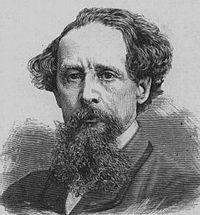
Charles John Huffam Dickens (7 February 1812 – 9 June 1870), pen-name «Boz», was the most popular English novelist of the Victorian era and one of the most popular of all time. He created some of literature’s most memorable characters. His novels and short stories have never gone out of print.A concern with what he saw as the pressing need for social reform is a theme that runs throughout his work.

Much of his work first appeared in periodicals and magazines in serialised form, a favoured way of publishing fiction at the time. Other writers of the time would complete entire novels before serial publication commenced, but Dickens often wrote his in parts, in the order in which they were meant to appear. The practice lent his stories a particular rhythm, punctuated by one cliffhanger after another to keep the public eager for the next instalment. Critics and fellow-novelists such as George Gissing and G. K. Chesterton have applauded Dickens for his mastery of prose, and for his teeming gallery of unique characters, many of whom have acquired iconic status in the English-speaking world. Others such as Henry James and Virginia Woolf have accused him of sentimentality and implausibility.

“Charles Dickens”.Wikipedia, The Free Encyclopedia. 23 octubre 2009

 http://en.wikipedia.org/wiki/Charles_Dickens